Museum of Maybe: The Truth About Britain’s Box Room
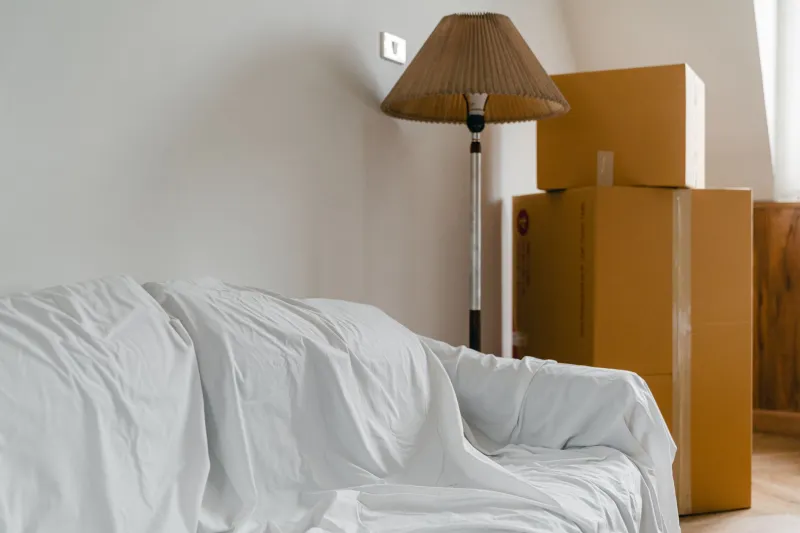
The box room is not really a room. It is a holding pattern. You know the one: roughly two metres by two, a window that opens six inches, and a carpet that has never quite recovered from the Argos flat-pack era. Officially, it is the spare bedroom. Practically, it is where the ironing board goes to think, where the Christmas tree lives in a bag shaped like a body, and where at least three lamps that no longer suit any room in the house are quietly waiting for a second act.
Every British home seems to have one. The estate agent calls it a ‘versatile third bedroom’. The family calls it ‘the box room’. And the guests who are promised a bed in it soon learn that ‘making up the spare room’ involves moving a sewing machine, a suitcase and a box marked ‘Cables?’ before anyone can find the pillowcases.
A room with a job title it never performs
There is something very British about designating a room for hospitality and then filling it with things you cannot quite bring yourself to throw away. The spare room is a social promise. The box room is the paperwork. It says: we are the sort of people who have guests. It also says: we are the sort of people who keep a dismantled desk ‘just in case’. Both things are true.
The clutter itself is rarely random. It is a museum of deferred decisions. The old lamp from the living room that was replaced but not discarded. The leftover laminate flooring from the hallway, kept because ‘there’s enough for a small job’. The bedding for a bed size you no longer own. The exercise bike that became a clothes horse and then a shelf. Each object has a story, and the story is almost always: I will deal with this later.
The archaeology of a British box room
If you excavate a box room, you tend to find layers. The bottom layer is usually furniture that was once in a main room and has been demoted: a pine bookcase, a bedside table with a water ring on top, a mirror that no longer matches anything. The middle layer is soft goods: spare duvets, mismatched sheets, a beanbag that has gone flat, towels kept for the garden or the dog. The top layer is pure 2026 life admin: delivery boxes, a returns bag, a parcel that was signed for by a neighbour in March and never collected.
Then there are the sentimental items that nobody wants to discuss. School reports. University posters. A box of photographs from a pre-digital holiday. The weird ceramics made by a relative. These are not clutter in the usual sense. They are emotional luggage, and moving them out of the house feels like making a judgement about the past. So they stay, behind the door, in the room nobody uses.
Who gets to decide? Family politics and the veto
Decluttering a box room is rarely a solo project. It is a negotiation with a veto system. One person is the keeper, one person is the chucker, and the box room is where their marriage or their shared tenancy gets tested. The keeper says, ‘That’s a good suitcase.’ The chucker says, ‘We have four suitcases.’ The keeper says, ‘Yes, but this one fits in the overhead locker.’ Nobody wins. The suitcase stays.
There is also the grief factor. Box rooms often hold the things that came from someone else’s house after a death or a downsizing: a box of ornaments, a stack of letters, a chair that was always in the corner of a grandparent’s front room. These objects carry a different weight. You cannot charity-shop a teapot that your nan used every day without feeling like you are making a statement about her. So it goes on the shelf in the box room, where it is safe and out of the way and quietly complicated.
The 2026 decluttering boom and the dent that wasn’t
It would be nice to report that the great decluttering mood of the mid-2020s has solved the box room. It has not. The rise of resale apps, the endless ‘one-in-one-out’ advice and the local council’s increasingly expensive bulky waste collection have changed the conversation, but they have not changed the room. If anything, they have added a step: now the old lamp sits in the box room while someone photographs it for a listing that never gets posted.
Charity shops are fuller, not emptier. The British Heart Foundation will take furniture, but it will not take the flat-pack bookcase that has been reassembled twice and still wobbles. Facebook Marketplace is a graveyard of ‘free to collector’ listings for things that are technically still useful and practically unwanted. And the loft is already full. So the box room absorbs the overflow, and the cycle continues.
The museum of maybe
Perhaps we should stop pretending the box room is a failure. It is one of the most honest rooms in the house. It is where a family’s indecision, sentiment and optimism are stored in physical form. The guest bed is made up maybe twice a year, but the room is used every day — as a reminder that life is complicated and that we are all, to some degree, keeping a broken lamp for a house we might live in one day.
Still, there is a middle path. Give the room a proper clear-out once a year, on a date you actually write down. Agree that anything not used or missed in twelve months can go. Be honest about the ‘might need it’ pile: if you cannot name the specific job it is for, it is not a spare; it is a decision you are avoiding. And keep one box for the things that genuinely matter. The rest is just the soundtrack of a very British room, humming quietly behind a closed door.