Excuse Me, Sorry, After You: The Silent Choreography of a Crowded Pavement
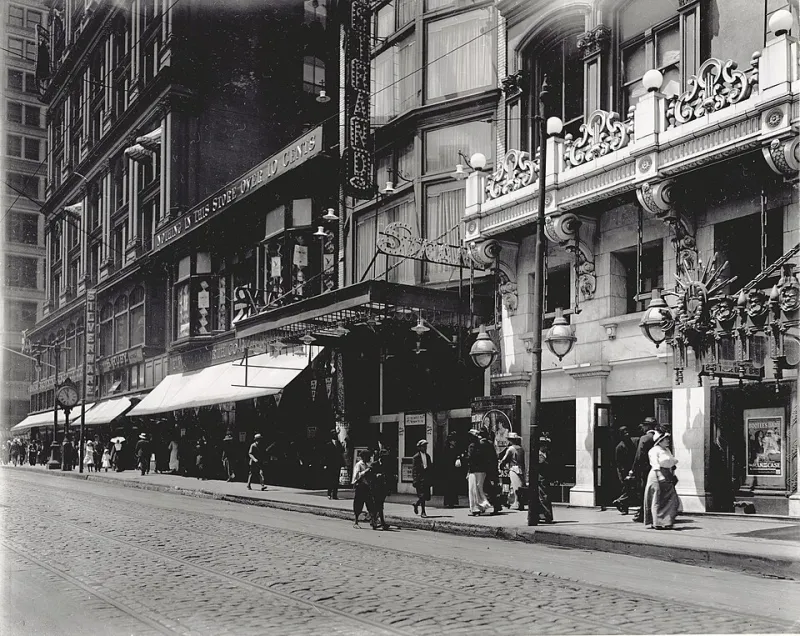
Photo: Unknown authorUnknown author, Public domain, via Wikimedia Commons
There is a particular moment, familiar to anyone who has walked a British high street on a Saturday, when two people approach each other on a stretch of pavement that is clearly not designed for two. The gap is there. Sort of. It exists in the way a spare seat on a busy train exists — technically available, socially complicated, and requiring a decision within about four seconds.
What follows is one of the last genuinely unscripted performances in public life. No app, no signage, no queue system. Just two humans, some bags, and a shared understanding that somebody is going to have to make themselves slightly smaller.
The half-second audit
Before anyone moves, an assessment happens. It is faster than conscious thought and considerably more detailed than it has any right to be.
Things get weighed: the width of the pavement, the presence of an A-board, a lamppost, a wheelie bin left out three days after collection. Whether the oncoming party is holding a hot drink. Whether they are on a phone, and if so, whether they are the sort of person who will look up. Whether there is a dog on a lead — and if so, whether the lead is the extendable kind, which changes the geometry of the situation entirely.
Somehow, we also factor in age, speed, and whether the other person has already clocked us. A person staring straight ahead with the fixed gaze of someone who has decided not to participate is a different proposition from someone who has made eye contact and offered that small, tight, upward twitch of the mouth that means: I see you, I acknowledge the squeeze, let's get through this.
The shop window manoeuvre
When the gap is genuinely too tight, Britain has a solution, and it is the shop window.
A sudden, absorbing interest in a display of waterproof jackets. A studied glance at a menu board for a restaurant you have no intention of entering. A rearrangement of a bag strap, performed with the intensity of someone defusing something.
This is not dishonesty, exactly. It is a face-saving device for both parties. By appearing to step aside voluntarily — because you have been drawn to the window rather than pushed off the path — you avoid the mild indignity of being the one who yielded. And the other person gets to walk on without the small debt of gratitude that a full, acknowledged concession would create.
It is a remarkably elegant piece of social engineering. Two strangers, one pavement, zero confrontation, and a fictional interest in a reasonably priced anorak.
The step and the counter-step
Sometimes, though, the manoeuvre fails — usually because both parties attempt to be polite at precisely the same moment.
You step left. They step left. You correct to the right. They have had the same idea. There is a brief, shuffling standoff that resembles a very low-budget dance routine, occasionally accompanied by a nervous laugh from one of you and a slightly tighter one from the other.
Eventually someone holds their ground, or a third party — a buggy, a postie, a delivery bike — interrupts the stalemate and forces a resolution. The encounter ends with a nod, or a muttered "sorry", which in this context means nothing of the sort. It means: no fault is being admitted, but the awkwardness is being shared.
The thank you with a job to do
British pavements are thick with thank-yous, and very few of them are straightforward gratitude.
There is the brisk "thanks" of someone who has stepped into the road to let you pass and would like it noted. There is the warmer "thank you!" of someone who has been shown a small kindness by a stranger carrying something unwieldy. And there is the entirely different "thank you" — delivered with the emphasis landing on the second word — which is the pavement's version of a raised eyebrow. It means the manoeuvre was clumsy, or unnecessary, or that you have taken a little longer than the situation strictly required.
It is a masterpiece of plausible deniability. Nothing has been said. Everything has been communicated.
Who gives way
There is no official hierarchy, but there is a working one, and most of us apply it without thinking.
Prams and wheelchairs tend to get the pavement. So do people carrying something large and breakable, and people visibly having a worse day than you. Dogs occupy an unpredictable middle ground. Posties, couriers and anyone pushing a trolley generally move with the confidence of someone who knows the rules do not apply to them and, more importantly, that nobody is going to argue.
Somewhere in the mix is a vague principle: whoever has the least to lose by yielding, yields. It is not fairness, exactly. It is closer to a shared instinct for keeping things moving, and it works far more often than it has any right to.
Where the code breaks down
Narrow pavements have their pressure points. A scaffolding tunnel with a single-file sign brings out the worst in everyone, largely because nobody trusts anyone else to wait their turn. Bus stops create accidental bottlenecks. School runs, market days, and the first warm weekend of the year, when every café spills its tables onto the paving, all push the system to its limits.
And in London, the audit changes. Eye contact drops, pace increases, and the shop window manoeuvre is replaced by a more efficient technique: the confident diagonal, performed without apology or acknowledgement, on the assumption that the other person will adjust. It works. It is not warm, but it works.
Elsewhere — a market town, a suburban parade of shops, a seaside promenade in August — the exchange is slower and more verbal. More nods. More weather-based small talk. More of that half-smile.
The last room with no algorithm
Most of our public negotiations now happen through screens. We book, queue and complain at a remove, with time to compose ourselves and an undo button within reach.
The pavement offers none of that. It is four seconds, eye contact, a decision, and the rest of the walk. It is one of the few remaining places where the British social code is enforced in real time, by ordinary people, with nothing more than a bag shuffle and a well-placed thank you.
Which is probably why, when someone does it well — steps aside, offers a nod, doesn't make a thing of it — the whole exchange feels quietly, disproportionately good. Small kindnesses, correctly timed, on a pavement barely wide enough for one.