The Rattle in the Drawer: What Britain's Button Tins Remember
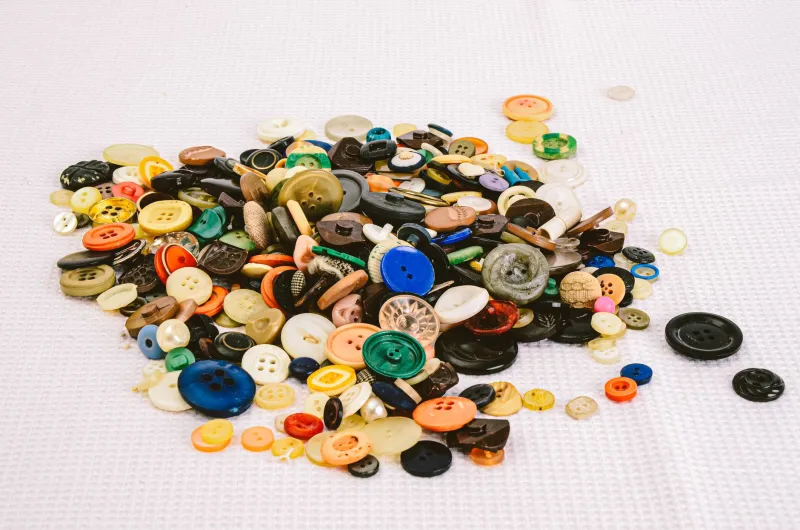
Every so often, usually while hunting for a torch battery or a takeaway menu, you open a kitchen drawer and hear it: a dry, plastic rattle. The button tin. It is rarely an actual button tin. More often it is a battered Quality Street tin, a shortbread tin with a Highland scene on the lid, or a clear plastic tub that once held something else entirely. Inside, a hundred small discs shift and settle. Some are white. Some are navy. A few are the colour of an old bruise. None of them, as far as you can tell, matches anything you currently own.
And yet the tin stays. It moves house with you. It survives kitchen clear-outs. It sits through conversations about decluttering and minimalism without a flicker of shame. Why?
A museum of garments that have already left
A button tin is an archive with no catalogue. Each button is a remnant of something: a coat that went to a charity shop, a cardigan that felted in the wash, a school blazer that was outgrown in a single summer. The garment is gone, but the button remains, and so does the vague, unexamined belief that it might be needed again.
Menders and makers call this a stash. The rest of us call it the tin. Either way, it is a small, domestic act of resistance against the idea that things simply end. The button says: this existed. The tin says: we are not finished with it yet.
The spare-button packet problem
Most of the buttons in any given tin did not arrive there by accident. They came stapled to a label. A new coat, a decent pair of trousers, a winter jacket — each one usually brings a tiny cellophane packet containing one spare button and a short length of matching thread. You cut it off, think about putting it somewhere safe, and drop it in the tin.
Then the coat wears out, or stops fitting, or goes out of style. Off it goes to the charity shop or the textile bank. The button stays. It is, in a quiet way, the longest-lasting part of the garment. The fabric gives up first. The button waits.
Why we never throw them away
There are practical reasons, of course. Buttons cost money. A replacement card at a haberdashery or a department store can set you back a few pounds, and matching an old button exactly is a fool's errand. Keeping a tin is cheaper than not keeping one.
But thrift is only half the story. The other half is something closer to superstition. Throwing away a tin of buttons feels like throwing away the possibility of repair. It is an admission that the mending is over, that the clothes have gone, that you are the sort of person who does not fix things. Nobody wants to be that person. So the tin stays.
The matching problem
Here is the great paradox of the button tin: it contains hundreds of buttons, and it almost never contains the one you need. You tip the whole lot onto the table, spread them out, and hunt for a 12mm navy plastic disc with a two-hole rim. You find 11mm. You find four-hole. You find a beautiful pearlescent one that belongs on a wedding dress. You do not find the one.
This is not a failure of the tin. It is the tin's true nature. It is not a hardware store. It is a collection of near-misses, a physical record of the fact that exact replacement is rare. Most repairs are approximate. Most mending is a compromise. The tin teaches you that.
A family archive with no labels
Some button tins are inherited. They arrive in a box of other things after a parent or grandparent dies, and they are almost impossible to throw away because they are almost impossible to identify. A large brown button might have come from a 1970s coat. A tiny white one could be from a baby cardigan. A metal one with an anchor on it is a mystery that nobody will ever solve.
These are not valuable objects. They are not antiques. But they are evidence. They are the small, unglamorous leftovers of ordinary lives, kept for no reason except that keeping them felt less final than throwing them away.
What the tin is really for
In 2026, you can order a pack of 50 assorted buttons from an online retailer for less than the price of a coffee. You can buy a sewing kit from a supermarket. You can, if you are so inclined, take a garment to a repair shop. The practical case for the button tin has never been weaker.
And yet it persists. It persists because it is not really about buttons. It is about the small, hopeful habit of keeping things on the off-chance. It is about the belief that a missing button is a temporary problem, that a torn seam can be fixed, that the clothes we love do not have to be disposable.
The tin is a tiny museum of maybe. It rattles when you open the drawer. It takes up almost no space. And somewhere in it, buried under a dozen mismatched white discs, is the button that will one day save a favourite coat from the bin. Probably. Maybe. That is enough.