Panel Beating: The Quiet Diplomacy of Britain’s Garden Fences
You rarely notice a garden fence until it changes. A panel disappears after a storm. A neighbour applies a suspiciously glossy new stain. Someone leans over the top and says, “Just checking you got my parcel” — and suddenly the whole back boundary feels like a small international summit.
Britain’s garden fences are not just property markers. They are a quiet language of neighbourly diplomacy: part planning law, part body language, part weather-resistant social contract. The fence itself may be six feet of feather-edge boarding from a DIY shed, but the rules around it are considerably more complicated.
The boundary is a state of mind
Most of us do not know exactly where our legal boundary is. The deeds may be vague, the title plan may be fuzzy, and the previous owner may have said something confident in 2019 that nobody has been able to verify since. So we rely on the fence. It is less a surveyor’s line and more a rumour with posts.
This is why the question of who owns the fence is such a British puzzle. There is no universal left-hand or right-hand rule, despite what people say at barbecues. Sometimes the fence belongs to one side; sometimes it is a shared party fence wall; sometimes it belongs to nobody in particular and everyone has been quietly maintaining it out of politeness since the 1990s. The etiquette fills the gap where the paperwork fails.
A good neighbour does not march outside with a tape measure. They observe. They infer. They wait until bin day and glance at the fence from a respectful distance, like a diplomat reading the mood of a foreign capital.
Six feet of feeling
Height is the most visible clause in the fence code. Broadly speaking, planning rules tend to treat two metres as the point where a rear garden fence starts needing permission, and front boundaries are subject to tighter limits. But the social height is different. The ideal fence is high enough to grant privacy and low enough to pass a bag of runner beans over without a stepladder.
A very tall fence can read as a statement. It says: I love my garden, and I love it without witnesses. A very low fence says: I am open to conversation, possibly more conversation than you planned. The middle ground is a kind of architectural small talk — present, polite, not demanding.
And then there is the trellis. A strip of trellis on top of a panel is not just for climbing plants. It is a diplomatic softening device, a way of saying “I would like a little more privacy” without building a fortress. It is the fencing equivalent of “no offence, but…”
The paint job as policy
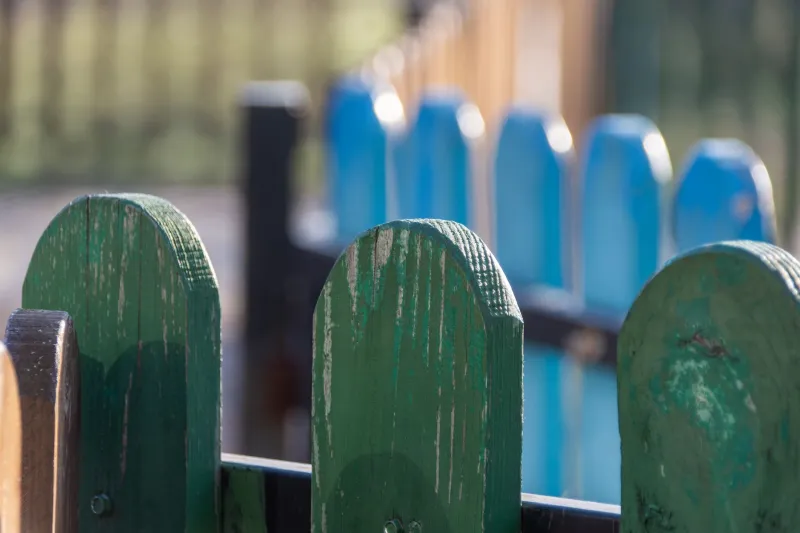
Nothing changes the atmosphere of a boundary like a fresh coat of wood stain. A neighbour who suddenly paints their side of the fence a deep forest green is not merely maintaining timber. They are making a public statement about order, taste and the general direction of the street.
Paint is also where the passive-aggressive possibilities multiply. If one side is freshly treated and the other is grey and weathered, the fence begins to look like a before-and-after advert for neighbourly effort. If somebody paints the “good side” — the smoother, nicer face of the panel — the other side may spend the rest of the summer wondering whether this was a kindness or a border announcement.
The safest approach is the one Britain has perfected over decades: admire the paint, do not comment on the colour, and absolutely do not offer unsolicited advice about preparation techniques. A fence can survive rain. It may not survive a neighbour saying, “You should have used a primer.”
The over-the-fence chat
Popping your head over a fence for a chat is one of the most anxious acts in suburban life. There is no invitation, no appointment and no obvious exit. You are essentially appearing from behind a wall like a friendly jack-in-the-box, and the other person must decide whether to stop weeding or pretend they have not seen you.
The timing matters. Mid-morning on a Saturday is generally acceptable. Just as someone is reversing off the drive is not. Nor is the moment they are carrying a tray of tomato plants, or wrestling a paddling pool back into its box.
A fence chat has its own choreography. The head appears first, then the shoulders. The weather is used as a visa. “You’ve got the sun over here” is not really about meteorology; it is a request for permission to linger. The fence is a loading screen for neighbourliness. You wait to see whether the conversation will load or time out.
Creosote and other ghosts
The old creosote smell is mostly a ghost now — a nostril-clearing memory of sheds, sleepers and summers past. But the idea of the fence as a defended border still lingers. A freshly treated fence can feel like a flag planted in the lawn: this is mine, I have maintained it, and I would prefer you did not lean on it with a mug of tea.
That is the strange contradiction at the heart of British fence etiquette. We want privacy, but we do not want to be the neighbour who built a wall. We want boundaries, but we want them to look natural. We want to keep ourselves to ourselves, preferably while exchanging a friendly nod over the top.
When a panel falls
Storm damage is the great test of fence diplomacy. A panel goes down, the garden is exposed, and suddenly both households can see each other’s wheelie bins in full. The question of who fixes it is rarely settled by a document. It is settled by a careful dance of offers, half-offers and strategic mentions of a man called Dave who “does fences”.
The wise move is not to assume. Offer to help. Ask whether they want to go halves. Do not turn up with a drill and a confident opinion about post depth. A fallen panel is a shared crisis even when the fence is privately owned, because privacy is a shared resource. The fence may belong to one household, but the awkwardness belongs to everyone.
The summit at the bin
Much of this diplomacy happens in small, unglamorous moments: the nod over the top while putting out the recycling, the brief conversation about whether the council has changed the collection day, the passing of a parcel across the boundary. These are the handshakes of the fence system. They keep the border friendly.
The best fences are boring. They do not dominate the garden or spark a campaign. They simply say: I am here, you are there, and that is fine. A good fence is not a wall. It is a filter — one that lets through a hello, a parcel and the occasional emergency loan of a screwdriver, while quietly keeping the rest at a comfortable distance.
So the next time you see a fresh coat of stain or a new panel on your neighbour’s side, treat it as a diplomatic cable. You do not need to reply immediately. A nod, a compliment and a well-timed retreat indoors will usually do.