The Case of the Vanishing Teaspoon: Inside Britain’s Office Kitchen Bermuda Triangle
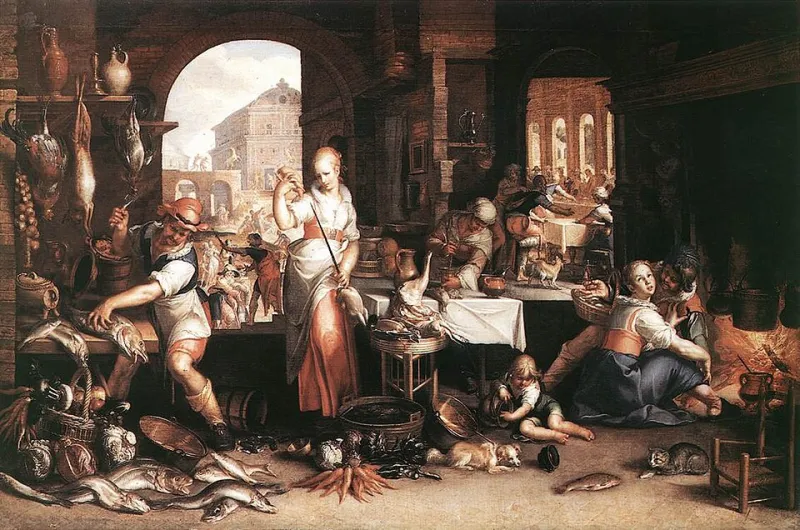
Photo: Joachim Wtewael, Public domain, via Wikimedia Commons
It is one of the great unsolved mysteries of British working life. You make a cup of tea. You stir it with the last clean teaspoon. You turn away for approximately ninety seconds. You turn back. The teaspoon is gone.
Not misplaced. Not hidden under a biscuit wrapper. Gone. Vanished into the same invisible portal that swallows biros, Tupperware lids and the will to live during a Tuesday afternoon meeting.
The office kitchen is a strange place. It is communal, but not quite public. It is domestic, but not quite home. And it runs on a set of unwritten rules that everyone resents and nobody enforces. At the centre of it all is the cutlery drawer: a graveyard of mismatched forks, a single rusty knife and a nagging sense that something is deeply wrong.
The scene of the crime
Walk into any UK office kitchen in autumn 2026 and you will find a version of the same scene. There is a fridge containing three unlabelled tubs of something that may once have been soup. There is a notice above the sink asking people to wash up after themselves, signed by someone who has clearly given up. There is a mug that says 'World’s Best Dad' and no one knows whose it is.
And then there is the cutlery drawer. It contains, typically, one teaspoon. Just one. It is the teaspoon equivalent of the last survivor in a horror film: slightly bent, faintly stained and aware that its time is coming.
Where do they go? The theories are varied and increasingly unhinged.
A short history of the communal mug
The office kitchen is a relatively modern invention, but the problems are ancient. Shared resources have always been a source of low-level friction. Medieval monasteries had rules about communal knives. Victorian households had strict hierarchies around who used which china. The office kitchen is simply the latest arena for the same old question: who is responsible for the stuff we all use?
The answer, in most British workplaces, is: nobody, and everybody, and also Sharon from accounts, who has bought her own mug and labels it with a Sharpie.
The communal mug is a particularly British phenomenon. It is not quite yours, but you would be annoyed if someone else used it. It sits in the cupboard, chipped and unclaimed, a monument to a workplace Christmas Secret Santa from 2019. Nobody washes it because nobody owns it. Nobody throws it away because it might belong to someone. It is the office equivalent of a stray cat.
The psychology of shared stuff
There is a concept psychologists call the tragedy of the commons. It describes what happens when a shared resource is used by individuals acting in their own self-interest. Each person takes a little more, gives a little less, and eventually the whole thing collapses. In the office kitchen, the commons is the teaspoon drawer, and the collapse is already well underway.
Part of the problem is diffusion of responsibility. If everyone is responsible for the teaspoons, then no one is. Washing up becomes a job for 'someone else'. Returning a borrowed fork becomes a vague intention rather than a concrete task. The teaspoon vanishes not because anyone is stealing it, but because it has entered a kind of cutlery limbo: moved from the drawer to a desk, then to a meeting room, then to a coat pocket, then to a home in Zone 4, where it lives out its retirement next to a jar of Marmite.
There is also the passive-aggressive note phenomenon. The office kitchen is one of the few places where British people will express anger indirectly, through laminated signs. 'PLEASE WASH YOUR MUGS' says one. 'THIS IS NOT YOUR MUM’S KITCHEN' says another. The notes multiply, but the teaspoons do not.
Reader theories from the drawer of truth
We asked around. The theories came thick and fast.
One colleague believes teaspoons are absorbed by the office carpet, which is also where paperclips go to die. Another suspects a secret teaspoon economy, run by the facilities team, in which cutlery is traded for biscuits. A third says the teaspoons are simply 'testing us' and that we are failing.
More plausible, perhaps, is the desk-drift theory. Teaspoons do not vanish; they migrate. They travel from the kitchen to the desk, from the desk to the meeting room, from the meeting room to the bin. They are not stolen so much as gradually lost, one small journey at a time.
And then there is the Tupperware lid corollary: any object that is part of a set will eventually lose its partner. The teaspoon is simply the most visible example. The forks are next.
Practical (and slightly petty) solutions
You cannot fix the office kitchen entirely. But you can try a few things.
First, label your mug. Not with a Post-it, which will fall off, but with permanent marker. Write your name on the bottom. It will not stop everyone, but it will stop you from accidentally drinking out of it in a moment of desperation.
Second, buy your own teaspoon and keep it in your desk drawer. This is technically a retreat from communal life, but it is also self-preservation. A personal teaspoon is a small act of dignity in a chaotic world.
Third, introduce a cutlery amnesty. Once a month, put a box in the kitchen and ask people to return any stray teaspoons, forks or mugs. No judgement. Just a quiet reintegration programme.
Fourth, and most controversially, accept that the drawer will never be full. The teaspoon is not a problem to be solved. It is a condition of office life. Like the printer jam and the meeting that could have been an email, it is simply part of the ecosystem.
The verdict
The office teaspoon is not really missing. It is distributed. It is in someone’s desk drawer, someone’s coat pocket, someone’s home kitchen. It has escaped the drawer and found a new life. We should be happy for it.
Meanwhile, the rest of us will carry on making tea, stirring it with whatever we can find and quietly wondering why the communal kitchen feels like a metaphor for something much larger. Perhaps it is. Or perhaps it is just a drawer full of lonely forks and a mug nobody dares wash. Either way, bring your own teaspoon.