The Warm Cupboard Files: Britain’s Airing Cupboard as a Domestic Archive
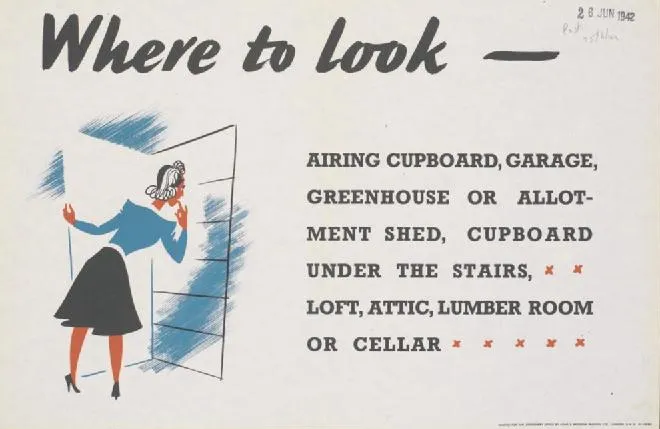
Photo: Unknown (artist), Lowe and Brydone Printers Ltd, London NW10 (printer), Her Majesty's Stationery Office (publisher/sponsor), Public domain, via Wikimedia Commons
Every home has a space that is not quite a room. It is too small for a chair, too warm for coats and too useful to ignore. In Britain, it is usually the airing cupboard: a narrow cavity built around a hot water cylinder, lined with slatted shelves, and stuffed with the kind of objects that never quite find another home. In 2026, when so much of domestic life has been streamlined, app-controlled and decluttered into submission, this warm little cupboard remains stubbornly analogue. It is part utility, part memory bank, and part archaeological site.
A cupboard with a job description
The airing cupboard began as a practical compromise. Put the hot water cylinder in a cupboard, add shelves, and let the residual heat do some quiet work: warming towels, drying washing, keeping sheets from feeling damp. In older houses, the cylinder might still be there, wrapped in its own lagging like a patient in a cardigan. In newer ones, the cupboard may survive the boiler it was built for, still warm-ish, still trusted, still full of bedding.
That is the first thing to understand about the airing cupboard. It is not a cupboard in the decorative sense. It is a working cupboard. It has a job. The fact that it also becomes a holding pen for half the house is simply a consequence of that job.
The archaeology of a shelf
Open the door and you are not looking at chaos. You are looking at layers. At the front: the towels you actually use, folded with varying degrees of conviction. Behind them: the better towels, the guest towels, the towels that are slightly too thin but still perfectly serviceable. Then the sheets, the spare duvet cover, the hot water bottle with a missing stopper, the electric blanket that may or may not work, and the small plastic bag of odd socks that nobody has audited since sometime in the last decade.
Deeper still, the cupboard becomes stranger. A tin of paint left over from a room that has since been repainted. A box for a phone that no longer exists. A candle shaped like a snowman, unburned. A gift bag saved for reuse. A present bought in September and hidden in October, now softly cooked by the cylinder and waiting for December. The airing cupboard is where good intentions go to stay warm.
This is not pure hoarding. It is closer to a filing system based on warmth, habit and hope. Things go in because they might be needed, because they do not belong anywhere else, or because throwing them away feels more effortful than keeping them. The shelves become a record of household decisions that were never quite made.
The sentimental boiler
The hot water cylinder itself is a relic in many homes, a stout cylinder of copper or steel that hums and clicks and occasionally needs the attentions of a plumber. Around it gather the cupboard’s supporting cast: a spare immersion heater, a length of lagging, a manual for a boiler that has been replaced twice, a fuse that probably fits something. These are not romantic objects. And yet there is something quietly reassuring about them. The cupboard is where the house admits it has machinery. It is where the practical and the personal are stored at the same temperature.
That is also why the airing cupboard can feel intimate without being secret. It holds the spare bedding, the old photographs that have not made it into an album, the letters tied with string, the Christmas decorations that are too fragile for the loft. It is not a vault. It is a shelf of deferred decisions.
Thrift, comfort and the British compromise
Airing cupboards make sense in a country that has long been suspicious of waste. The post-war make-do-and-mend instinct did not vanish; it simply moved indoors and found slatted shelving. Keeping a spare towel, a spare sheet, a spare bulb, a spare anything is not just practical. It is a small act of self-reliance. The cupboard is the domestic equivalent of a raincoat folded in a bag.
Comfort matters too. A warm towel on a cold morning is a tiny luxury that costs nothing extra if the cylinder is already doing its thing. In an era of energy awareness, the airing cupboard has acquired a new layer of meaning. It is a drying room for the clothes that cannot go outside, a warm place for the cat to sleep, and a reminder that not every useful space in a home needs to be beautiful.
There is also something British about the cupboard’s awkwardness. It is rarely a showpiece. The door may be low, the shelves may be cramped, and reaching the back requires a kind of controlled fall. We tolerate it because it works. The airing cupboard is a national talent for making do, expressed in plywood and folded cotton.
The awkward door and the unspoken etiquette
Guests do not usually open the airing cupboard. It is not locked, but it is understood to be private. It sits in the hallway or the bathroom, close enough to daily life to be ordinary, far enough from the front room to be overlooked. To open it in someone else’s house would feel like reading their diary, or checking their fridge without being asked.
That quiet privacy is part of its charm. The cupboard knows the household’s small truths: which towels are for best, which sheets are for guests, which gifts were bought and forgotten, which boiler part was kept just in case. It is not glamorous, but it is honest.
What the warm cupboard says about us
Britain’s airing cupboard is a small museum of practical affection. It holds comfort in the form of warm towels, thrift in the form of things kept, and memory in the form of objects that have outlived their moment but not their meaning. It is a cupboard that works, and a cupboard that remembers.
Next time you open one, pause for a second. Look at the layers. Somewhere between the spare duvet and the unopened gift, there is a story about how we live: warmly, awkwardly, and with one eye always on a day that might need a spare towel.